
Number System in Computer
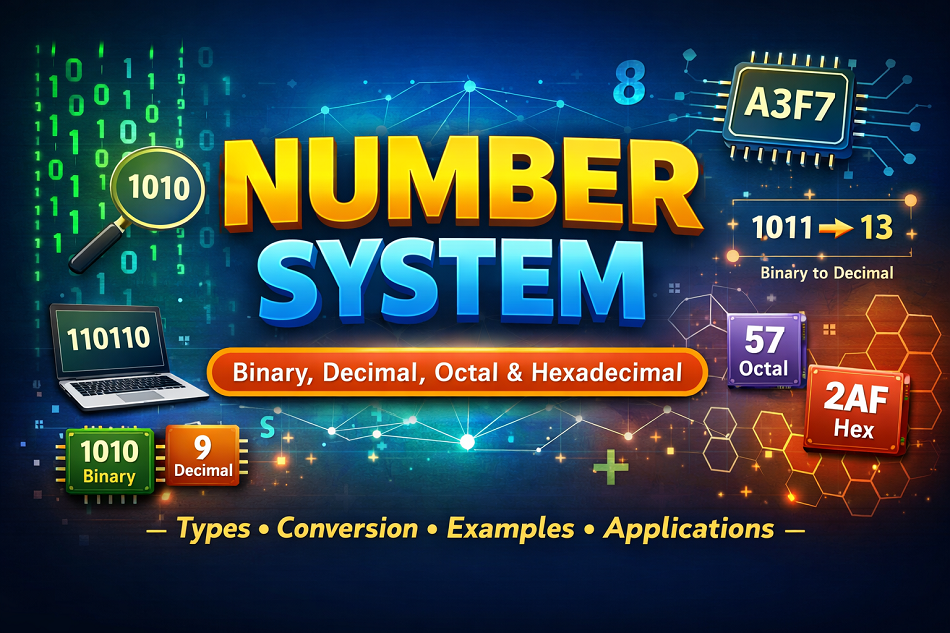
Introduction to Computer Number System
The Computer Number System is the backbone of computer architecture and digital electronics. Every operation performed by a computer, from simple calculations to complex programming tasks, depends on the computer's number system. Unlike the mathematical number system used for theoretical calculations, the computer number system is designed for machine-level processing and data representation.
In this article, you will learn what is computer number system is, its definition, types of computer number systems, number system conversion, advantages, and applications in computers, explained and more.
What is the Computer Number System?
Definition of Computer Number System
Highlighted Definition:
The Computer Number System is a method used by computers to represent, store, and process data using different base values such as binary, octal, decimal, and hexadecimal.
Computers do not understand letters, words, or symbols directly. They only understand numbers, especially binary digits (0 and 1). Therefore, different number systems are used to make communication between humans and computers easier.
Why is the Computer Number System Important?
The importance of the computer number system lies in how computers operate internally.
Importance of the Number System in Computing
- Computers understand only binary data
- All programs are converted into machine language
- Memory storage uses number systems
- CPU operations depend on binary logic
- Helps in data encoding and decoding
- Used in networking, graphics, and system design
Types of Computer Number Systems
The types of computer number systems are classified based on the base (radix) used.
Main Types of Number Systems in Computers
- Decimal Number System
- Binary Number System
- Octal Number System
- Hexadecimal Number System
1. Decimal Number System
Definition of Decimal Number System
The decimal number system uses base 10 and consists of digits from 0 to 9. This system is mainly used by humans for daily calculations.
Base of the Decimal Number System
- Base (Radix): 10
- Digits: 0–9
Example of Decimal Number System
Number: 259
Expanded form:
(2 × 10²) + (5 × 10¹) + (9 × 10⁰)
Use of the Decimal System in Computing
- Input and output operations
- User interface display
- Human-readable format
2. Binary Number System
Definition of Binary Number System
The binary number system uses base 2 and consists of only two digits: 0 and 1.
Highlighted Definition:
The binary number system is the fundamental number system used by computers to process and store data.
Base of the Binary Number System
- Base (Radix): 2
- Digits: 0, 1
Example of the Binary Number System
Binary Number: 1011
Decimal Equivalent:
(1 × 2³) + (0 × 2²) + (1 × 2¹) + (1 × 2⁰) = 11
Why do Computers Use the Binary Number System?
- Easy to represent electronic signals (ON/OFF)
- High reliability and accuracy
- Simple hardware design
- Less error-prone processing
3. Octal Number System
Definition of Octal Number System
The octal number system uses base 8 and digits from 0 to 7.
Base of Octal Number System
- Base (Radix): 8
- Digits: 0–7
Example of Octal Number System
Octal Number: 157
Decimal Equivalent:
(1 × 8²) + (5 × 8¹) + (7 × 8⁰)
Use of the Octal Number System in Computers
- Short representation of binary numbers
- Used in early computing systems
- UNIX file permissions
4. Hexadecimal Number System
Definition of Hexadecimal Number System
The hexadecimal number system uses base 16 and includes digits 0–9 and letters A–F.
Base of the Hexadecimal Number System
- Base (Radix): 16
- Digits: 0–9, A–F
Hexadecimal Digits Meaning
- A = 10
- B = 11
- C = 12
- D = 13
- E = 14
- F = 15
Example of the Hexadecimal Number System
Hexadecimal Number: 2F
Decimal Equivalent:
(2 × 16¹) + (15 × 16⁰)
Applications of the Hexadecimal Number System
- Memory addresses
- Machine-level programming
- Color codes in web development
- Debugging and system design
Number System Conversion in Computer
Number system conversion is the process of converting numbers from one base to another.
Common Number System Conversions
- Binary to Decimal
- Decimal to Binary
- Binary to Octal
- Binary to Hexadecimal
- Hexadecimal to Decimal
Binary to Decimal Conversion
Steps:
- Write the binary number
- Multiply each digit by powers of 2
- Add all the values
Binary to Decimal Conversion
Steps:
- Write the binary number
- Multiply each digit by powers of 2
- Add all the values
Advantages of the Computer Number System
Advantages
- Efficient data processing
- Simple hardware implementation
- High-speed operations
- Accurate calculations
- Easy data storage and transmission
Applications of the Computer Number System
The computer number system is widely used in:
- Computer programming
- Digital electronics
- Microprocessors
- Networking systems
- Operating systems
- Database management
- Artificial intelligence
Difference Between Computer Number System and Mathematical Number System
| Computer Number System | Mathematical Number System |
|---|---|
| Used in computers | Used in mathematics |
| Binary-based processing | Concept-based calculations |
| Machine-level operations | Theoretical operations |
| Digital representation | Abstract representation |
Frequently Asked Questions (FAQ)
1. What is a Computer Number System?
The Computer Number System is a method used by computers to represent, store, and process data using different base values such as binary, decimal, octal, and hexadecimal. Computers mainly use the binary number system to perform all operations internally.
2. Why do computers use the binary number system?
Computers use the binary number system because electronic circuits can easily represent two states:
- 0 (OFF)
- 1 (ON)
This makes data processing fast, reliable, and accurate, and simplifies hardware design.
3. What are the types of computer number systems?
The main types of computer number systems are:
- Decimal Number System (Base 10)
- Binary Number System (Base 2)
- Octal Number System (Base 8)
- Hexadecimal Number System (Base 16)
4. What is the base (radix) of a number system?
The base or radix of a number system refers to the total number of digits used in that system.
- Binary → Base 2
- Octal → Base 8
- Decimal → Base 10
- Hexadecimal → Base 16
5. What is the binary number system in computers?
The binary number system is a base-2 number system that uses only 0 and 1. It is the fundamental number system of computers, used for data storage, processing, and communication.
6. What is the use of the decimal number system in computers?
The decimal number system is mainly used for:
- User input
- Output display
- Human-computer interaction
Internally, computers convert decimal numbers into binary form for processing.
7. Why are octal and hexadecimal number systems used?
Octal and hexadecimal number systems are used because they provide:
- Shorter representation of binary numbers
- Easier readability
- Simplified debugging and memory addressing
Hexadecimal is especially popular in computer programming and system design.
8. What is the number system conversion in a computer?
Number system conversion is the process of converting a number from one base to another, such as:
- Binary to Decimal
- Decimal to Binary
- Binary to Hexadecimal
- Hexadecimal to Decimal
Conversions are essential for programming, debugging, and understanding computer operations.
9. What is the hexadecimal number system used for?
The hexadecimal number system is used in:
- Memory addresses
- Machine code representation
- Web color codes
- Debugging programs
- Low-level system programming
10. What is the difference between the binary and decimal number systems?
| Binary Number System | Decimal Number System |
|---|---|
| Base 2 | Base 10 |
| Uses 0 and 1 | Uses 0 to 9 |
| Used by computers | Used by humans |
| Machine-level processing | Human-readable format |
11. Is the computer number system important for programming?
Yes, understanding the computer number system is very important for programming because:
- Data is stored in binary format
- Memory and registers use binary values
- Bitwise operations depend on number systems
- Low-level programming requires number system knowledge
12. Which number system is used internally by computers?
Computers use the binary number system internally for all calculations, data storage, and logical operations.
13. What are the advantages of the computer number system?
Some major advantages are:
- Efficient data processing
- Simple hardware design
- High speed and accuracy
- Reliable digital communication
- Easy data storage and transfer
14. What is the role of the computer number system in digital electronics?
In digital electronics, the computer number system is used to:
- Design logic circuits
- Represent signals
- Perform arithmetic operations
Control hardware behavior
15. Is the computer number system part of the computer science syllabus?
Yes, the computer number system is a core topic in:
- Computer Science
- Information Technology
- Digital Electronics
- Engineering courses
- Competitive exams
Conclusion
The Computer Number System is a fundamental concept in computer science that enables computers to store, process, and communicate data efficiently. Understanding binary, decimal, octal, and hexadecimal number systems is essential for students, programmers, and IT professionals.
From machine-level operations to high-level programming, the computer number system ensures accuracy, speed, and reliability in digital systems. A strong grasp of this topic builds a solid foundation for learning computer architecture, programming, and digital electronics.
Leave a Comment
Your email address will not be published. Required fields are marked *
Related Post
Git & GitHub Version Control Tutorial for Beginners
Learn Git & GitHub Version Control with this complete beginner-to-advanced guide. Understand Git commands, repositories, branching, merging,
CI/CD Pipelines Complete Guide – Continuous Integration
Learn everything about CI/CD Pipelines in this complete guide. Understand Continuous Integration, Continuous Deployment.
DevOps: Ultimate Guide to DevOps Practices, Tools
Explore the complete DevOps guide for 2026. Learn DevOps practices, tools, benefits, CI/CD pipelines, automation, culture, and more.
What is Cloud Platforms? Types, Benefits
Learn everything about Cloud Platforms. Understand cloud computing platforms, types, benefits, services, use cases, security, and future trends.
Encryption: Types, Algorithms, Security and Data Encryption
Learn everything about Encryption in this complete guide. Understand what encryption is, types of encryption, algorithms, advantages, data security.
Ethical Hacking: Complete Guide, Tools, Techniques
Learn Ethical Hacking in this complete guide. Understand ethical hackers, types, tools, techniques, and cybersecurity best practices.
Network Security and Firewalls – Types, Architecture
Learn Network Security & Firewalls in detail. This complete guide covers concepts, types of firewalls, architecture, security threats, and more.
Network Routing and Switching – Types, Protocols & Working
Learn everything about Network Routing and Switching. Understand concepts, types, protocols, devices, differences, advantages, and more.
IP Addressing - IPv4, IPv6, Working, Types, Structure, Security
Internet Protocol (IP) is the foundation of the internet. Learn everything about IP, including IPv4, IPv6, IP addressing, packet delivery, and more.
Transmission Control Protocol (TCP) - Working, Features, Use
Learn everything about Transmission Control Protocol (TCP) in this complete SEO-friendly guide. Understand TCP definition, and more.