
Hexadecimal Number System
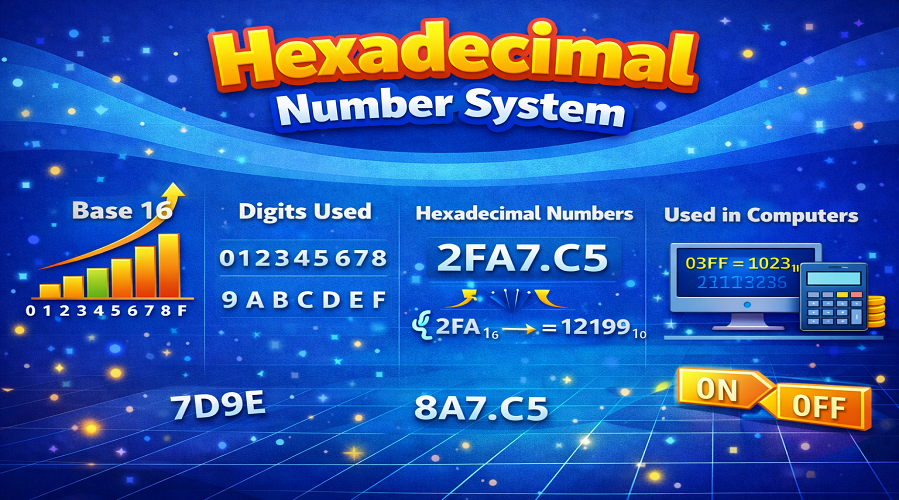
Introduction to Hexadecimal Number System
The Hexadecimal Number System is one of the most important number systems used in computer science, digital electronics, and programming. While humans generally use the decimal number system (base 10), computers internally work with binary (base 2). However, binary numbers are long and difficult for humans to read and understand.
To solve this problem, the hexadecimal number system was introduced. It provides a compact, readable, and efficient representation of binary data. Hexadecimal numbers are widely used in memory addressing, machine-level programming, color codes in web design, debugging, networking, and embedded systems.
This article explains the hexadecimal number system from basic to advanced level, making it suitable for students, programmers, competitive exam aspirants, and beginners.
What is the Hexadecimal Number System?
The Hexadecimal Number System is a positional number system with base 16. It uses 16 unique symbols to represent numbers.
Definition
Hexadecimal Number System is a number system that uses 16 digits (0–9 and A–F) to represent numerical values.
Base of Hexadecimal Number System
- Base (Radix): 16
- Each digit position represents a power of 16
Place Values in Hexadecimal
| Position | Value |
|---|---|
| 16⁰ | 1 |
| 16¹ | 16 |
| 16² | 256 |
| 16³ | 4096 |
| 16⁴ | 65536 |
Digits Used in Hexadecimal Number System
Hexadecimal uses numbers and alphabets:
| Decimal Value | Hex Digit |
|---|---|
| 0 – 9 | 0 – 9 |
| 10 | A |
| 11 | B |
| 12 | C |
| 13 | D |
| 14 | E |
| 15 | F |
Why Letters Are Used?
Since a single digit can only represent 0–9, letters A to F are used to represent values 10 to 15.
Representation of Hexadecimal Numbers
Hexadecimal numbers are often written with:
- Prefix: 0x (in programming)
- Suffix: H (in electronics)
Examples:
- Decimal 255 → Hexadecimal FF
- Hexadecimal number: 0x2A
- Electronics notation: 3FH
Why Hexadecimal Number System is Important?
Hexadecimal plays a crucial role in computing because:
- Binary numbers are too long
- Decimal numbers are inefficient for computers
- Hexadecimal provides shorter and readable binary representation
- 1 hex digit = 4 binary bits
Binary to Hex Mapping
| Binary | Hex |
|---|---|
| 0000 | 0 |
| 0001 | 1 |
| 0010 | 2 |
| 0011 | 3 |
| 0100 | 4 |
| 0101 | 5 |
| 0110 | 6 |
| 0111 | 7 |
| 1000 | 8 |
| 1001 | 9 |
| 1010 | A |
| 1011 | B |
| 1100 | C |
| 1101 | D |
| 1110 | E |
| 1111 | F |
Conversion of Hexadecimal Number System
1. Hexadecimal to Decimal Conversion
Method:
Multiply each digit by 16 raised to its position.
Example:
Convert 2A₁₆ to decimal.
2 × 16¹ + A × 16⁰ 2 × 16 + 10 × 1 32 + 10 = 42
2A₁₆ = 42₁₀
2. Decimal to Hexadecimal Conversion
Method:
Repeated division by 16.
Example:
Convert 156₁₀ to hexadecimal.
156 ÷ 16 = 9 remainder 12 (C) 9 ÷ 16 = 0 remainder 9
Reading from bottom to top:
156₁₀ = 9C₁₆
3. Hexadecimal to Binary Conversion
Each hex digit is replaced with 4-bit binary equivalent.
Example:
Convert 3F₁₆ to binary.
3 = 0011 F = 1111
3F₁₆ = 00111111₂
4. Binary to Hexadecimal Conversion
Steps:
- Group binary digits in sets of 4 (from right)
- Convert each group to hex
Example:
Binary: 11010110
1101 → D 0110 → 6
11010110₂ = D6₁₆
5. Hexadecimal to Octal Conversion
Steps:
- Convert Hex → Binary
- Convert Binary → Octal
6. Octal to Hexadecimal Conversion
Steps:
- Convert Octal → Binary
- Convert Binary → Hexadecimal
Hexadecimal Arithmetic Operations
1. Hexadecimal Addition
Example:
A5 + 3F ----
Step-by-step:
- 5 + F = 14₁₀ = 14 - 16 → 4 carry 1
- A + 3 + 1 = E
Result = E4
2. Hexadecimal Subtraction
Example:
B2 - 4F ----
Borrow when required, similar to decimal subtraction but base 16.
3. Hexadecimal Multiplication
Similar to decimal multiplication, but digits range from 0–F.
4. Hexadecimal Division
Performed like long division with base 16.
Comparison with Other Number Systems
| Feature | Binary | Octal | Decimal | Hexadecimal |
|---|---|---|---|---|
| Base | 2 | 8 | 10 | 16 |
| Digits | 0–1 | 0–7 | 0–9 | 0–9, A–F |
| Human Readability | Low | Medium | High | High |
| Computer Use | Very High | Medium | Low | Very High |
Uses of Hexadecimal Number System
1. Computer Programming
- Memory addresses
- Machine code
- Debugging
2. Web Development
- HTML/CSS color codes
Example: #FF5733
3. Digital Electronics
- Microprocessors
- Embedded systems
4. Networking
- MAC addresses
- IPv6 addresses
5. Operating Systems
- Memory dumps
- Kernel debugging
6. Cryptography
- Hash values
- Encryption keys
Advantages of Hexadecimal Number System
- Compact representation of binary
- Easy conversion to/from binary
- Reduces errors
- Human-readable format
- Efficient for low-level programming
Disadvantages of Hexadecimal Number System
- Not intuitive for non-technical users
- Requires understanding of binary
- Limited direct arithmetic use in daily life
Hexadecimal in Programming Languages
Most programming languages support hexadecimal notation.
Examples:
- C, C++, Java, Python: 0x1A
- Assembly language: 1AH
Common Hexadecimal Examples
| Decimal | Hexadecimal |
|---|---|
| 10 | A |
| 15 | F |
| 16 | 10 |
| 31 | 1F |
| 255 | FF |
| 1024 | 400 |
Frequently Asked Questions (FAQs)
What is the base of hexadecimal number system?
The base of the hexadecimal number system is 16.
Why hexadecimal is used in computers?
Because it provides a shorter and readable form of binary numbers.
How many bits are in one hexadecimal digit?
One hexadecimal digit equals 4 bits.
Is hexadecimal better than binary?
Hexadecimal is not better internally, but better for human readability.
Where is hexadecimal used?
In programming, memory addressing, networking, web colors, and electronics.
Conclusion
The Hexadecimal Number System is a powerful and essential number system in the digital world. By using base 16, it bridges the gap between binary machine language and human understanding. Its applications span across computer science, electronics, networking, programming, and web development.
Understanding hexadecimal improves your grasp of low-level computing concepts, enhances programming skills, and prepares you for technical exams and real-world applications. Whether you are a student, developer, or tech enthusiast, mastering hexadecimal is a valuable skill in today’s digital era.
Leave a Comment
Your email address will not be published. Required fields are marked *
Related Post
Git & GitHub Version Control Tutorial for Beginners
Learn Git & GitHub Version Control with this complete beginner-to-advanced guide. Understand Git commands, repositories, branching, merging,
CI/CD Pipelines Complete Guide – Continuous Integration
Learn everything about CI/CD Pipelines in this complete guide. Understand Continuous Integration, Continuous Deployment.
DevOps: Ultimate Guide to DevOps Practices, Tools
Explore the complete DevOps guide for 2026. Learn DevOps practices, tools, benefits, CI/CD pipelines, automation, culture, and more.
What is Cloud Platforms? Types, Benefits
Learn everything about Cloud Platforms. Understand cloud computing platforms, types, benefits, services, use cases, security, and future trends.
Encryption: Types, Algorithms, Security and Data Encryption
Learn everything about Encryption in this complete guide. Understand what encryption is, types of encryption, algorithms, advantages, data security.
Ethical Hacking: Complete Guide, Tools, Techniques
Learn Ethical Hacking in this complete guide. Understand ethical hackers, types, tools, techniques, and cybersecurity best practices.
Network Security and Firewalls – Types, Architecture
Learn Network Security & Firewalls in detail. This complete guide covers concepts, types of firewalls, architecture, security threats, and more.
Network Routing and Switching – Types, Protocols & Working
Learn everything about Network Routing and Switching. Understand concepts, types, protocols, devices, differences, advantages, and more.
IP Addressing - IPv4, IPv6, Working, Types, Structure, Security
Internet Protocol (IP) is the foundation of the internet. Learn everything about IP, including IPv4, IPv6, IP addressing, packet delivery, and more.
Transmission Control Protocol (TCP) - Working, Features, Use
Learn everything about Transmission Control Protocol (TCP) in this complete SEO-friendly guide. Understand TCP definition, and more.