
Binary Number System
Introduction to Binary Number System
The Binary Number System is the foundation of all modern computer systems. Every computer, mobile phone, calculator, and digital device works internally using binary numbers. Unlike the decimal number system, which humans use in daily life, computers rely entirely on the binary number system to store, process, and communicate data.
Understanding the binary number system is essential for anyone learning:
- Computer fundamentals
- Programming languages
- Digital electronics
- Information technology
- Computer science
In this article, we will explain the binary number system step by step, starting from the basics and moving toward advanced concepts, using simple words and clear examples.
What is Binary Number System? (Definition)
Definition of Binary Number System
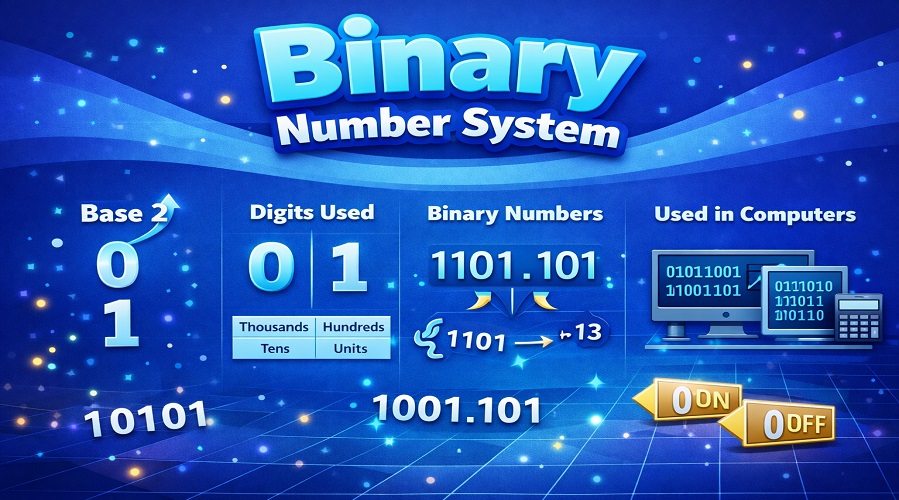
The Binary Number System is a number system that uses only two digits: 0 and 1 to represent all numbers and data.
- It is also known as a base-2 number system
- Each digit in a binary number is called a bit
- Binary numbers are used by computers to perform calculations and store information
Highlighted Explanation
Binary Number System = Number system with only two digits (0 and 1)
Base of Binary Number System
Every number system has a base (also called radix).
Base of Binary Number System
- The base of the binary number system is 2
- This means it uses two digits only
Comparison with Other Number Systems
- Decimal Number System → Base 10
- Binary Number System → Base 2
- Octal Number System → Base 8
- Hexadecimal Number System → Base 16
Why Base Matters?
The base determines:
- How many digits are used
- How place values increase
- How numbers are calculated
Digits Used in Binary Number System
The binary number system uses only two digits:
- 0
- 1
Meaning of Binary Digits
- 0 represents OFF, FALSE, or LOW voltage
- 1 represents ON, TRUE, or HIGH voltage
Highlighted Point
Binary digits are perfect for electronic circuits because circuits can easily detect ON (1) and OFF (0) states.
Binary Number Representation
Binary numbers represent values using powers of 2.
Place Value System in Binary
Each position in a binary number has a value based on powers of 2:
- Rightmost position → 2⁰
- Next position → 2¹
- Next → 2²
- And so on
Example of Binary Representation
Binary Number: 1011
| Position | Power of 2 | Value |
|---|---|---|
| 1 | 2³ | 8 |
| 0 | 2² | 0 |
| 1 | 2¹ | 2 |
| 1 | 2⁰ | 1 |
Total Value = 8 + 0 + 2 + 1 = 11 (Decimal)
Binary to Decimal Conversion
Binary to decimal conversion is done by multiplying each binary digit with its place value and adding the results.
Steps
- Write the binary number
- Assign powers of 2 from right to left
- Multiply each digit by its power
- Add all values
Example
Binary: 1101
- (1 × 2³) = 8
- (1 × 2²) = 4
- (0 × 2¹) = 0
- (1 × 2⁰) = 1
Decimal Result = 13
Decimal to Binary Conversion
Decimal to binary conversion is done using repeated division by 2.
Steps
- Divide the decimal number by 2
- Note the remainder
- Divide the quotient again by 2
- Continue until quotient becomes 0
- Read remainders from bottom to top
Example
Decimal: 10
- 10 ÷ 2 = 5 remainder 0
- 5 ÷ 2 = 2 remainder 1
- 2 ÷ 2 = 1 remainder 0
- 1 ÷ 2 = 0 remainder 1
Binary Result = 1010
Importance of Binary Number System
The binary number system is essential in computing and digital technology.
Reasons for Importance
- Easy to represent using electronic circuits
- Reliable data storage
- Efficient data processing
- Error detection and correction
- Universal language of computers
Highlighted Statement
Without the binary number system, modern computers and digital devices would not exist.
Why do Computers Use Binary Number System?
Computers use the binary number system because of hardware simplicity and reliability.
Main Reasons
- Electronic components have two stable states
- Binary reduces hardware complexity
- Binary logic is easier to design
- Less error-prone compared to multi-state systems
Binary and Transistors
- Transistors act as switches
- ON = 1
- OFF = 0
This makes binary the perfect match for computer hardware.
Bits and Bytes
What is a Bit?
- A bit is the smallest unit of data
- It can store either 0 or 1
What is a Byte?
- A byte consists of 8 bits
- Used to store characters and symbols
Common Data Units
- 1 bit = 0 or 1
- 1 byte = 8 bits
- 1 KB = 1024 bytes
- 1 MB = 1024 KB
- 1 GB = 1024 MB
Binary Arithmetic Basics
Binary arithmetic is similar to decimal arithmetic but simpler.
Binary Addition
Rules:
- 0 + 0 = 0
- 0 + 1 = 1
- 1 + 0 = 1
- 1 + 1 = 10 (carry 1)
Example
101 + 011 = 1000
Binary Subtraction
Rules:
- 0 − 0 = 0
- 1 − 0 = 1
- 1 − 1 = 0
- 0 − 1 = borrow
Binary Multiplication
Rules:
- 0 × 0 = 0
- 0 × 1 = 0
- 1 × 0 = 0
- 1 × 1 = 1
Binary multiplication is simpler than decimal multiplication.
Binary Logic and Boolean Algebra
Binary numbers are closely related to Boolean logic.
Basic Logic Gates
- AND
- OR
- NOT
Example
- AND: 1 AND 1 = 1
- OR: 1 OR 0 = 1
- NOT: NOT 1 = 0
These gates form the basis of all computer operations.
Binary Number System in Memory Storage
Computers store data in memory using binary numbers.
How Data is Stored
- Characters are stored using binary codes
- Numbers are stored in binary form
- Images, audio, and video are converted into binary data
Popular Binary Encoding Systems
- ASCII
- Unicode
- UTF-8
Binary Number System vs Decimal Number System
Key Differences
- Binary uses 0 and 1
- Decimal uses 0 to 9
- Binary is machine-friendly
- Decimal is human-friendly
Highlighted Comparison
Humans think in decimal, computers think in binary.
Advantages of Binary Number System
- Simple electronic implementation
- High reliability
- Noise-resistant
- Easy data processing
- Efficient storage
Limitations of Binary Number System
- Longer representation for large numbers
- Difficult for humans to read
- Needs conversion for user interaction
Applications of Binary Number System
Binary numbers are used in:
- Computers
- Mobile phones
- Digital clocks
- Communication systems
- Internet data transfer
- Programming languages
Conclusion
The Binary Number System is the backbone of digital technology. From simple calculations to complex artificial intelligence systems, everything depends on binary numbers. Understanding binary concepts such as bits, bytes, binary arithmetic, and representation is essential for anyone interested in computers and technology.
Leave a Comment
Your email address will not be published. Required fields are marked *
Related Post
Git & GitHub Version Control Tutorial for Beginners
Learn Git & GitHub Version Control with this complete beginner-to-advanced guide. Understand Git commands, repositories, branching, merging,
CI/CD Pipelines Complete Guide – Continuous Integration
Learn everything about CI/CD Pipelines in this complete guide. Understand Continuous Integration, Continuous Deployment.
DevOps: Ultimate Guide to DevOps Practices, Tools
Explore the complete DevOps guide for 2026. Learn DevOps practices, tools, benefits, CI/CD pipelines, automation, culture, and more.
What is Cloud Platforms? Types, Benefits
Learn everything about Cloud Platforms. Understand cloud computing platforms, types, benefits, services, use cases, security, and future trends.
Encryption: Types, Algorithms, Security and Data Encryption
Learn everything about Encryption in this complete guide. Understand what encryption is, types of encryption, algorithms, advantages, data security.
Ethical Hacking: Complete Guide, Tools, Techniques
Learn Ethical Hacking in this complete guide. Understand ethical hackers, types, tools, techniques, and cybersecurity best practices.
Network Security and Firewalls – Types, Architecture
Learn Network Security & Firewalls in detail. This complete guide covers concepts, types of firewalls, architecture, security threats, and more.
Network Routing and Switching – Types, Protocols & Working
Learn everything about Network Routing and Switching. Understand concepts, types, protocols, devices, differences, advantages, and more.
IP Addressing - IPv4, IPv6, Working, Types, Structure, Security
Internet Protocol (IP) is the foundation of the internet. Learn everything about IP, including IPv4, IPv6, IP addressing, packet delivery, and more.
Transmission Control Protocol (TCP) - Working, Features, Use
Learn everything about Transmission Control Protocol (TCP) in this complete SEO-friendly guide. Understand TCP definition, and more.