
Octal Number System
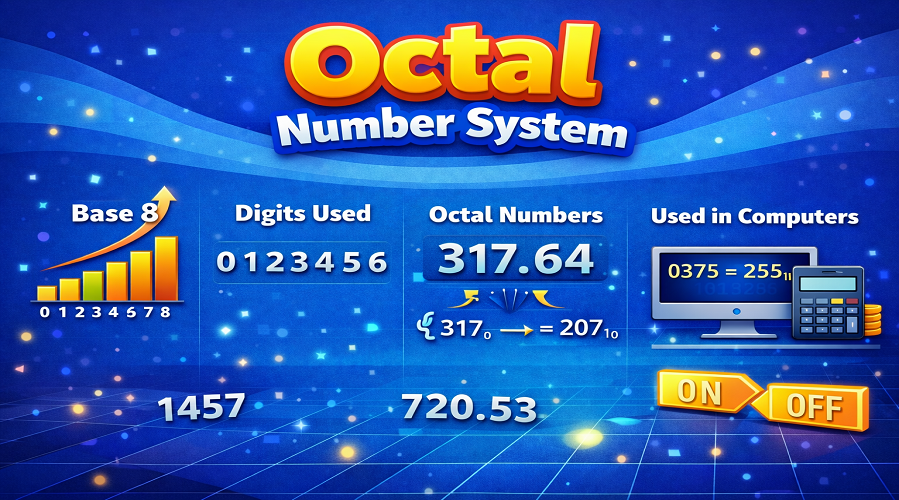
Introduction to Octal Number System
The Octal Number System is one of the most important number systems used in computer science and digital electronics. Although it is not as popular as the Binary Number System or Decimal Number System, it plays a significant role in simplifying complex binary values.
The octal system uses base 8, which means it consists of 8 unique digits. These digits help represent large binary numbers in a shorter and more readable form. Due to this reason, octal numbers were widely used in early computer systems, microprocessors, and digital logic design.
What is the Octal Number System?
The Octal Number System is a positional number system that uses base 8. In this system, only eight digits are used to represent numbers.
Digits Used in Octal Number System
The digits allowed in the octal system are:
- 0
- 1
- 2
- 3
- 4
- 5
- 6
- 7
Digits 8 and 9 are not allowed in the octal number system.
Each digit has a place value based on powers of 8, starting from right to left.
Base of Octal Number System
- Base = 8
This means:
- Each position represents a power of 8
- From right to left:
- 8⁰, 8¹, 8², 8³, and so on
Example of Place Values
For an octal number 347₈:
| Digit | Place Value | Calculation |
|---|---|---|
| 7 | 8⁰ | 7 × 1 |
| 4 | 8¹ | 4 × 8 |
| 3 | 8² | 3 × 64 |
Why is Octal Number System Used?
The octal number system is mainly used because it provides a compact representation of binary numbers.
Reasons for Using the Octal Number System
- It reduces long binary strings
- Easy conversion between binary and octal
- Useful in computer programming and digital systems
- Helps in understanding machine-level data
- It was widely used in early computing systems
Representation of Octal Numbers
An octal number is usually represented with a subscript 8 to distinguish it from other number systems.
Example
- 125₈ → Octal Number
- 125₁₀ → Decimal Number
Conversion of Octal Number System
Conversions are a crucial part of understanding any number system. Below are all important conversions related to the octal number system.
1. Octal to Decimal Conversion
To convert an octal number into decimal, follow these steps:
Steps
- Write the place value of each digit using powers of 8
- Multiply each digit by its place value
- Add all the results
Example
Convert 345₈ into decimal.
- 5 × 8⁰ = 5
- 4 × 8¹ = 32
- 3 × 8² = 192
Decimal Value = 5 + 32 + 192 = 229₁₀
2. Decimal to Octal Conversion
To convert a decimal to octal, use the repeated division method.
Steps
- Divide the decimal number by 8
- Note the remainder
- Divide the quotient again by 8
- Continue until the quotient becomes 0
- Read the remainders from bottom to top
Example
Convert 156₁₀ to octal.
- 156 ÷ 8 = 19 → remainder 4
- 19 ÷ 8 = 2 → remainder 3
- 2 ÷ 8 = 0 → remainder 2
Octal Value = 234₈
3. Octal to Binary Conversion
Octal to binary conversion is very easy because each octal digit corresponds to 3 binary bits.
Octal to Binary Mapping Table
- 0 → 000
- 1 → 001
- 2 → 010
- 3 → 011
- 4 → 100
- 5 → 101
- 6 → 110
- 7 → 111
Steps
- Replace each octal digit with its 3-bit binary equivalent
- Combine all binary groups
Example
Convert 572₈ to binary.
- 5 → 101
- 7 → 111
- 2 → 010
Binary Value = 101111010₂
4. Binary to Octal Conversion
Binary to octal conversion is done by grouping binary digits into sets of three.
Steps
- Start grouping binary digits from right to left
- Make groups of 3 bits
- Convert each group to its octal equivalent
Example
Convert 110101011₂ to octal.
- 110 → 6
- 101 → 5
- 011 → 3
Octal Value = 653₈
5. Octal to Hexadecimal Conversion
Octal to hexadecimal conversion is usually done via binary.
Steps
- Convert octal to binary
- Convert binary to hexadecimal
This indirect method ensures accuracy.
Octal Number System Examples
Example 1
Octal Number: 72₈
Decimal Value:
- 2 × 8⁰ = 2
- 7 × 8¹ = 56
Answer = 58₁₀
Example 2
Decimal Number: 89₁₀
Octal Value:
- 89 ÷ 8 = 11 → remainder 1
- 11 ÷ 8 = 1 → remainder 3
- 1 ÷ 8 = 0 → remainder 1
Answer = 131₈
Advantages of Octal Number System
The octal number system offers several advantages, especially in computing.
Main Advantages
- Shorter representation of binary numbers
- Easy conversion to and from binary
- Reduces errors while reading long binary values
- Useful in low-level programming
- Simplifies machine-level instructions
Disadvantages of Octal Number System
Despite its benefits, the octal system has limitations.
Main Disadvantages
- Not commonly used in modern systems
- Less efficient than hexadecimal
- Difficult for non-technical users
- Limited real-world applications today
Applications of Octal Number System
The octal number system has been used in various fields, especially in early computing.
Major Applications
- Early computer systems
- Digital electronics
- Microprocessor design
- UNIX file permission representation
- Educational purposes in computer fundamentals
Difference Between Octal and Other Number Systems
Octal vs Decimal
- Octal base is 8
- Decimal base is 10
- Octal used in computers
- Decimal used in daily life
Octal vs Binary
- Octal is compact
- Binary is machine-readable
- Octal simplifies binary data
Octal vs Hexadecimal
- Octal uses base 8
- Hexadecimal uses base 16
- Hexadecimal is more popular today
Octal Number System in Computer Science
In computer science, the octal number system is used to:
- Represent machine instructions
- Simplify binary data
- Teach number system concepts
- Understand low-level programming
UNIX and Linux systems still use octal values to represent file permissions, which makes octal numbers relevant even today.
What is the Octal Number System?
The Octal Number System is a positional number system that uses base 8. In this system, only eight digits are used to represent numbers.
Digits Used in Octal Number System
The digits allowed in the octal system are:
- 0
- 1
- 2
- 3
- 4
- 5
- 6
- 7
Digits 8 and 9 are not allowed in the octal number system.
Each digit has a place value based on powers of 8, starting from right to left.
Base of Octal Number System
- Base = 8
This means:
- Each position represents a power of 8
- From right to left:
- 8⁰, 8¹, 8², 8³, and so on
Example of Place Values
For an octal number 347₈:
| Digit | Place Value | Calculation |
|---|---|---|
| 7 | 8⁰ | 7 × 1 |
| 4 | 8¹ | 4 × 8 |
| 3 | 8² | 3 × 64 |
Why is Octal Number System Used?
The octal number system is mainly used because it provides a compact representation of binary numbers.
Reasons for Using Octal Number System
- It reduces long binary strings
- Easy conversion between binary and octal
- Useful in computer programming and digital systems
- Helps in understanding machine-level data
- Was widely used in early computing systems
Representation of Octal Numbers
An octal number is usually represented with a subscript 8 to distinguish it from other number systems.
Example
- 125₈ → Octal Number
- 125₁₀ → Decimal Number
Conversion of Octal Number System
Conversions are a crucial part of understanding any number system. Below are all important conversions related to the octal number system.
1. Octal to Decimal Conversion
To convert an octal number into decimal, follow these steps:
Steps
- Write the place value of each digit using powers of 8
- Multiply each digit by its place value
- Add all the results
Example
Convert 345₈ into decimal.
- 5 × 8⁰ = 5
- 4 × 8¹ = 32
- 3 × 8² = 192
Decimal Value = 5 + 32 + 192 = 229₁₀
2. Decimal to Octal Conversion
To convert decimal to octal, use the repeated division method.
Steps
- Divide the decimal number by 8
- Note the remainder
- Divide the quotient again by 8
- Continue until quotient becomes 0
- Read the remainders from bottom to top
Example
Convert 156₁₀ to octal.
- 156 ÷ 8 = 19 → remainder 4
- 19 ÷ 8 = 2 → remainder 3
- 2 ÷ 8 = 0 → remainder 2
Octal Value = 234₈
3. Octal to Binary Conversion
Octal to binary conversion is very easy because each octal digit corresponds to 3 binary bits.
Octal to Binary Mapping Table
- 0 → 000
- 1 → 001
- 2 → 010
- 3 → 011
- 4 → 100
- 5 → 101
- 6 → 110
- 7 → 111
Steps
- Replace each octal digit with its 3-bit binary equivalent
- Combine all binary groups
Example
Convert 572₈ to binary.
- 5 → 101
- 7 → 111
- 2 → 010
Binary Value = 101111010₂
4. Binary to Octal Conversion
Binary to octal conversion is done by grouping binary digits into sets of three.
Steps
- Start grouping binary digits from right to left
- Make groups of 3 bits
- Convert each group to its octal equivalent
Example
Convert 110101011₂ to octal.
- 110 → 6
- 101 → 5
- 011 → 3
Octal Value = 653₈
5. Octal to Hexadecimal Conversion
Octal to hexadecimal conversion is usually done via binary.
Steps
- Convert octal to binary
- Convert binary to hexadecimal
This indirect method ensures accuracy.
Octal Number System Examples
Example 1
Octal Number: 72₈
Decimal Value:
- 2 × 8⁰ = 2
- 7 × 8¹ = 56
Answer = 58₁₀
Example 2
Decimal Number: 89₁₀
Octal Value:
- 89 ÷ 8 = 11 → remainder 1
- 11 ÷ 8 = 1 → remainder 3
- 1 ÷ 8 = 0 → remainder 1
Answer = 131₈
Advantages of Octal Number System
The octal number system offers several advantages, especially in computing.
Main Advantages
- Shorter representation of binary numbers
- Easy conversion to and from binary
- Reduces errors while reading long binary values
- Useful in low-level programming
- Simplifies machine-level instructions
Disadvantages of Octal Number System
Despite its benefits, the octal system has limitations.
Main Disadvantages
- Not commonly used in modern systems
- Less efficient than hexadecimal
- Difficult for non-technical users
- Limited real-world applications today
Applications of Octal Number System
The octal number system has been used in various fields, especially in early computing.
Major Applications
- Early computer systems
- Digital electronics
- Microprocessor design
- UNIX file permission representation
- Educational purposes in computer fundamentals
Difference Between Octal and Other Number Systems
Octal vs Decimal
- Octal base is 8
- Decimal base is 10
- Octal used in computers
- Decimal used in daily life
Octal vs Binary
- Octal is compact
- Binary is machine-readable
- Octal simplifies binary data
Octal vs Hexadecimal
- Octal uses base 8
- Hexadecimal uses base 16
- Hexadecimal is more popular today
Octal Number System in Computer Science
In computer science, the octal number system is used to:
- Represent machine instructions
- Simplify binary data
- Teach number system concepts
- Understand low-level programming
UNIX and Linux systems still use octal values to represent file permissions, which makes octal numbers relevant even today.
Octal number representation is an important concept in computer science and digital systems. It provides a simple and efficient way to represent binary data in a shorter and more readable format. Since computers internally work with binary digits (0 and 1), understanding how these binary values can be represented using octal numbers is essential for students, programmers, and system designers.
The octal number representation uses base 8, which means every number is expressed using eight possible digits. The key advantage of octal representation is that each octal digit corresponds exactly to three binary bits, making conversion and interpretation easy.
This article explains octal number representation in detail, including its meaning, structure, methods, examples, advantages, limitations, and importance in computer systems.
What is Octal Number Representation?
Octal number representation is the method of expressing numbers using the octal number system, which has a base of 8. In this representation, values are written using digits from 0 to 7 only.
Digits Used in Octal Representation
- 0
- 1
- 2
- 3
- 4
- 5
- 6
- 7
Digits 8 and 9 are not allowed in octal representation.
Each digit in an octal number has a positional value based on powers of 8.
Base and Place Value System in Octal Representation
The octal number system follows a positional place value system, just like decimal and binary systems.
Base of Octal Representation
- Base = 8
Place Values
From right to left, place values increase as powers of 8:
- 8⁰
- 8¹
- 8²
- 8³
- 8⁴
Example of Place Value
For the octal number 462₈:
- 2 × 8⁰
- 6 × 8¹
- 4 × 8²
This place value structure is the foundation of octal number representation.
Why Octal Number Representation is Used
The main reason for using octal number representation is its direct relationship with binary numbers.
Reasons for Using Octal Representation
- Binary numbers are very long
- Octal representation reduces length
- Each octal digit equals 3 binary bits
- Easier for humans to read and write
- Useful in low-level computing
Relationship Between Binary and Octal Representation
Binary and octal number representations are closely related.
Key Relationship
- 1 octal digit = 3 binary digits
- Binary digits are grouped in sets of three
- Each group is replaced by an octal digit
Binary to Octal Mapping
- 000 → 0
- 001 → 1
- 010 → 2
- 011 → 3
- 100 → 4
- 101 → 5
- 110 → 6
- 111 → 7
This relationship makes octal representation extremely useful in computers.
Methods of Octal Number Representation
There are different methods used to represent numbers in octal form.
1. Direct Octal Representation
In this method, the number is already written using digits 0 to 7, so it is directly considered an octal number.
Example
- 157₈
- 640₈
These numbers are already in octal representation.
2. Decimal to Octal Representation
Decimal numbers can be represented in octal using the repeated division method.
Steps
- Divide the decimal number by 8
- Write the remainder
- Divide the quotient again by 8
- Repeat until quotient becomes 0
- Read remainders from bottom to top
Example
Decimal: 125
- 125 ÷ 8 = 15 remainder 5
- 15 ÷ 8 = 1 remainder 7
- 1 ÷ 8 = 0 remainder 1
Octal Representation = 175₈
3. Binary to Octal Representation
Binary to octal representation is the most important method in computers.
Steps
- Group binary digits into sets of three (from right)
- Convert each group into its octal equivalent
- Combine all octal digits
Example
Binary: 101110011
Groups:
- 101 → 5
- 110 → 6
- 011 → 3
Octal Representation = 563₈
4. Octal to Binary Representation
This method converts octal digits back into binary form.
Steps
- Replace each octal digit with its 3-bit binary value
- Combine all binary groups
Example
Octal: 247
- 2 → 010
- 4 → 100
- 7 → 111
Binary Representation = 010100111
5. Fractional Octal Number Representation
Octal representation is not limited to integers. It can also represent fractional values.
Place Values for Fractions
- 8⁻¹
- 8⁻²
- 8⁻³
Example
Octal: 12.34₈
- 1 × 8¹
- 2 × 8⁰
- 3 × 8⁻¹
- 4 × 8⁻²
This method is used in precision-based computing.
Octal Number Representation with Examples
Example 1
Octal: 345
Decimal Representation:
- 5 × 8⁰ = 5
- 4 × 8¹ = 32
- 3 × 8² = 192
Decimal Value = 229
Example 2
Binary: 111001
Groups:
- 111 → 7
- 001 → 1
Octal Representation = 71₈
Octal Representation in Computer Systems
Octal number representation has played a major role in computer systems.
Areas of Use
- Machine code representation
- Memory addressing
- Instruction decoding
- File permission systems
- Embedded system programming
Octal Representation in UNIX and Linux
One of the most practical uses of octal representation today is in UNIX and Linux file permissions.
Permission Values
- Read = 4
- Write = 2
- Execute = 1
Example
- 755
- 644
- 777
These values are octal representations of permission bits.
1. What is the base of the octal number system?
The base of the octal number system is 8.
2. How many digits are used in octal number system?
Eight digits are used: 0 to 7.
3. Is octal number system still used today?
Yes, it is used in UNIX file permissions and education.
4. Why is octal easier than binary?
Because it represents 3 binary bits with one digit, making numbers shorter.
5. Can digits 8 and 9 be used in octal?
No, digits 8 and 9 are not allowed.
Conclusion
The Octal Number System is an important part of computer science and digital electronics. It serves as a bridge between binary numbers and human understanding. Although modern systems prefer hexadecimal, octal numbers still play a crucial role in learning, system permissions, and low-level computing concepts.
Leave a Comment
Your email address will not be published. Required fields are marked *
Related Post
Git & GitHub Version Control Tutorial for Beginners
Learn Git & GitHub Version Control with this complete beginner-to-advanced guide. Understand Git commands, repositories, branching, merging,
CI/CD Pipelines Complete Guide – Continuous Integration
Learn everything about CI/CD Pipelines in this complete guide. Understand Continuous Integration, Continuous Deployment.
DevOps: Ultimate Guide to DevOps Practices, Tools
Explore the complete DevOps guide for 2026. Learn DevOps practices, tools, benefits, CI/CD pipelines, automation, culture, and more.
What is Cloud Platforms? Types, Benefits
Learn everything about Cloud Platforms. Understand cloud computing platforms, types, benefits, services, use cases, security, and future trends.
Encryption: Types, Algorithms, Security and Data Encryption
Learn everything about Encryption in this complete guide. Understand what encryption is, types of encryption, algorithms, advantages, data security.
Ethical Hacking: Complete Guide, Tools, Techniques
Learn Ethical Hacking in this complete guide. Understand ethical hackers, types, tools, techniques, and cybersecurity best practices.
Network Security and Firewalls – Types, Architecture
Learn Network Security & Firewalls in detail. This complete guide covers concepts, types of firewalls, architecture, security threats, and more.
Network Routing and Switching – Types, Protocols & Working
Learn everything about Network Routing and Switching. Understand concepts, types, protocols, devices, differences, advantages, and more.
IP Addressing - IPv4, IPv6, Working, Types, Structure, Security
Internet Protocol (IP) is the foundation of the internet. Learn everything about IP, including IPv4, IPv6, IP addressing, packet delivery, and more.
Transmission Control Protocol (TCP) - Working, Features, Use
Learn everything about Transmission Control Protocol (TCP) in this complete SEO-friendly guide. Understand TCP definition, and more.