
Keyword Research Process

Introduction to Keyword Research Process
The Keyword Research Process is the foundation of Search Engine Optimization (SEO). Without proper keyword research, even the best-written content may never reach its target audience. Keyword research helps you understand what users are searching for, why they are searching, and how competitive those searches are.
In simple words, keyword research is the process of finding, analyzing, and selecting the right keywords that your potential audience uses in search engines like Google, Bing, and Yahoo.
Whether you are a beginner blogger, digital marketer, SEO expert, or business owner, mastering the keyword research process is essential for:
- Driving organic traffic
- Improving search engine rankings
- Increasing click-through rate (CTR)
- Boosting conversions
What Is Keyword Research?
Keyword Research is the practice of identifying words and phrases (keywords) that people type into search engines to find information, products, or services.
Example
If someone searches:
- “best laptop for programming”
- “how to learn SEO”
- “keyword research process”
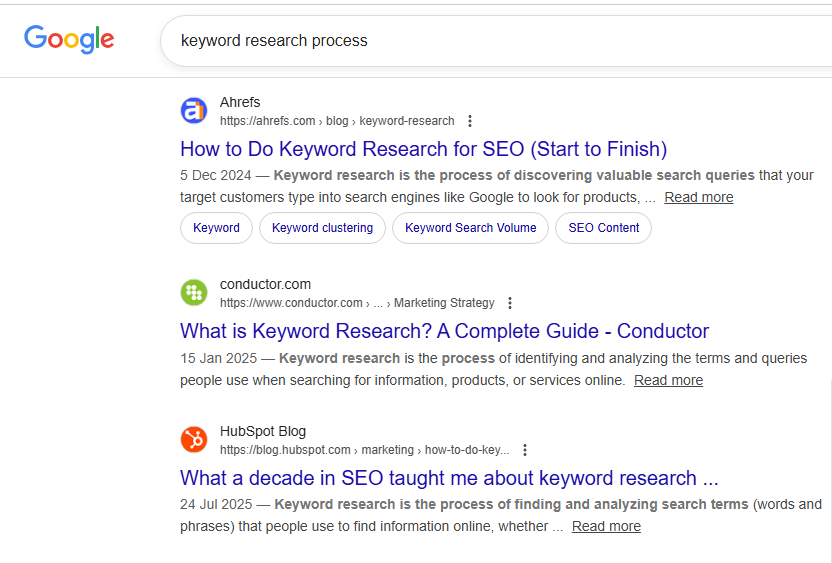
These phrases are keywords.
Why Keyword Research Is Important for SEO
Keyword research plays a critical role in SEO because:
1. Understand User Behavior
It helps you understand what your audience actually wants.
2. Better Content Strategy
You can create content that directly answers user queries.
3. Higher Rankings
Optimized keywords improve your chances of ranking on Google.
4. Increased Organic Traffic
Targeting the right keywords brings relevant visitors.
5. Higher Conversions
The right keywords attract users who are ready to take action.
Types of Keywords in SEO
Understanding keyword types is an important part of the keyword research process.
1. Short-Tail Keywords
- Length: 1–2 words
- Example: SEO, laptop
- High search volume, high competition
2. Long-Tail Keywords
- Length: 3+ words
- Example: keyword research process for SEO
- Lower competition, higher conversion rate
3. Branded Keywords
- Example: Google Analytics, Ahrefs
4. Non-Branded Keywords
- Example: SEO tools, keyword planner
5. Transactional Keywords
- Example: buy SEO tool, best hosting plan
6. Informational Keywords
- Example: What is keyword research
7. Navigational Keywords
- Example: Ahrefs login
Step-by-Step Keyword Research Process
Now, let’s understand the complete keyword research process step by step.
Step 1: Define Your Goals
Before starting keyword research, you must be clear about your goals.
Ask yourself:
- Do you want traffic?
- Do you want sales?
- Do you want leads?
- Do you want brand awareness?
Your goal will decide:
- Keyword type
- Content format
- Search intent
Step 2: Understand Your Target Audience
Knowing your audience is essential in the keyword research process.
Consider the following:
- Age group
- Location
- Language
- Interests
- Problems & pain points
Example
If your audience is beginners:
- Use simple keywords
- Avoid technical jargon
Step 3: Search Intent Analysis (Very Important)
Search Intent Analysis means understanding why a user is searching for a keyword.
Google ranks content based on search intent.
Types of Search Intent
1. Informational Intent
User wants information.
Example:
- What is keyword research
- How SEO works
2. Navigational Intent
User wants a specific website.
Example:
- Google Search Console login
3. Transactional Intent
The user wants to buy something.
Example:
- Buy a keyword research tool
4. Commercial Investigation
The user wants to compare before buying.
Example:
- Best SEO tools 2025
Why Search Intent Matters
If your content does not match search intent, it will not rank—even with strong keywords.
Step 4: Brainstorm Seed Keywords
Seed keywords are basic keywords related to your topic.
Example for Keyword Research Topic
- keyword research
- SEO keywords
- keyword planner
- keyword analysis
These seed keywords are used to generate more keyword ideas.
Step 5: Use Keyword Research Tools
Keyword research tools make the process faster and more accurate.
Popular Keyword Research Tools
1. Google Keyword Planner
- Free
- Best for beginners
- Shows keyword volume & competition
2. Google Search Console
- Shows keywords you already rank for
3. Google Search Suggestions
- Autocomplete
- “People Also Ask”
- Related Searches
4. Ahrefs
- Advanced competitor analysis
- Keyword difficulty score
5. SEMrush
- Keyword gap analysis
- Keyword trends
6. Ubersuggest
- Beginner-friendly
- Affordable
Step 6: Analyze Keyword Volume
Keyword Volume shows how many times a keyword is searched per month.
Types of Keyword Volume
- High Volume: More traffic, high competition
- Medium Volume: Balanced traffic and competition
- Low Volume: Easier to rank, niche audience
Best Practice
Do not target only high-volume keywords. Focus on relevant and achievable keywords.
Step 7: Keyword Difficulty Analysis
Keyword Difficulty (KD) indicates how hard it is to rank for a keyword.
Factors Affecting Keyword Difficulty
- Authority of top-ranking websites
- Quality of content
- Backlinks
- Domain age
Keyword Difficulty Scale
- 0–20: Easy
- 21–40: Medium
- 41–60: Hard
- 61+: Very competitive
Tip
For new websites, target low to medium difficulty keywords.
Step 8: Competitor Keyword Research
Competitor keyword research helps you find keywords your competitors are already ranking for.
How to Do Competitor Keyword Research
- Identify top competitors
- Enter competitor URL into the SEO tool
- Analyze:
- Ranking keywords
- Traffic keywords
- Content gaps
Benefits
- Saves time
- Proven keyword ideas
- Helps outrank competitors
Step 9: Identify Seasonal Keywords
Seasonal keywords perform well only during specific times.
Examples
- Diwali offers
- Black Friday deals
- Summer fashion trends
- Christmas gifts

Tool for Seasonal Keywords
- Google Trends
Why Seasonal Keywords Matter
They can bring massive traffic in a short time if planned correctly.
Step 10: Analyze Keyword Trends
Keyword trends help you understand whether a keyword is:
- Growing
- Declining
- Stable
Use Google Trends
- Compare multiple keywords
- Identify rising topics
- Plan content calendar
Step 11: Keyword Mapping (Content Planning)
Keyword Mapping is the process of assigning keywords to specific pages.
Why Keyword Mapping Is Important
- Avoids keyword cannibalization
- Improves site structure
- Enhances user experience
Example
| Page | Target Keyword |
|---|---|
| Blog Post | Keyword research process |
| Category Page | SEO keyword tools |
| Landing Page | Best SEO services |
Step 12: Group Keywords by Topic (Keyword Clustering)
Keyword clustering means grouping similar keywords together.
Benefits
- One page ranks for multiple keywords
- Better topical authority
- Improved SEO performance
Step 13: On-Page Keyword Optimization
After finalizing keywords, place them properly:
Where to Add Focus Keywords
- Title tag
- Meta description
- URL
- H1, H2, H3 headings
- First 100 words
- Image ALT text
- Internal links
⚠️ Avoid keyword stuffing.
Common Keyword Research Mistakes
- Ignoring search intent
- Targeting only high-volume keywords
- Not checking keyword difficulty
- No competitor analysis
- Poor keyword mapping
Advanced Keyword Research Strategies
1. Question-Based Keywords
Use tools like:
- AnswerThePublic
- Google PAA
2. Voice Search Keywords
Optimize for:
- Conversational queries
- Long-tail keywords
3. Local Keyword Research
Add:
- City
- Area
- Near me
Best Practices for Keyword Research Process
- Always focus on user intent
- Combine data + logic
- Update keywords regularly
- Track performance using analytics
- Create high-quality content
Future of Keyword Research
With AI and voice search growing, keyword research is evolving:
- Semantic search
- Topic clusters
- User behavior signals
- AI-powered keyword tools
FAQs – Keyword Research Process
Q1. What is the best keyword research tool?
Google Keyword Planner, Ahrefs, and SEMrush are among the best.
Q2. How many keywords should I target per page?
One primary keyword and 3–5 secondary keywords.
Q3. Is keyword research still important in SEO?
Yes, it is the backbone of SEO.
Q4. Can I rank without keyword research?
Possible, but not scalable or sustainable.
Conclusion
The Keyword Research Process is not just about finding keywords—it is about understanding users, intent, and competition. A strong keyword research strategy helps you create content that ranks, converts, and builds long-term authority.
If you follow the steps explained in this guide—search intent analysis, competitor keyword research, keyword difficulty, keyword volume, seasonal keywords, and keyword mapping—you will build a powerful SEO foundation for your website.
Leave a Comment
Your email address will not be published. Required fields are marked *
Related Post
Git & GitHub Version Control Tutorial for Beginners
Learn Git & GitHub Version Control with this complete beginner-to-advanced guide. Understand Git commands, repositories, branching, merging,
CI/CD Pipelines Complete Guide – Continuous Integration
Learn everything about CI/CD Pipelines in this complete guide. Understand Continuous Integration, Continuous Deployment.
DevOps: Ultimate Guide to DevOps Practices, Tools
Explore the complete DevOps guide for 2026. Learn DevOps practices, tools, benefits, CI/CD pipelines, automation, culture, and more.
What is Cloud Platforms? Types, Benefits
Learn everything about Cloud Platforms. Understand cloud computing platforms, types, benefits, services, use cases, security, and future trends.
Encryption: Types, Algorithms, Security and Data Encryption
Learn everything about Encryption in this complete guide. Understand what encryption is, types of encryption, algorithms, advantages, data security.
Ethical Hacking: Complete Guide, Tools, Techniques
Learn Ethical Hacking in this complete guide. Understand ethical hackers, types, tools, techniques, and cybersecurity best practices.
Network Security and Firewalls – Types, Architecture
Learn Network Security & Firewalls in detail. This complete guide covers concepts, types of firewalls, architecture, security threats, and more.
Network Routing and Switching – Types, Protocols & Working
Learn everything about Network Routing and Switching. Understand concepts, types, protocols, devices, differences, advantages, and more.
IP Addressing - IPv4, IPv6, Working, Types, Structure, Security
Internet Protocol (IP) is the foundation of the internet. Learn everything about IP, including IPv4, IPv6, IP addressing, packet delivery, and more.
Transmission Control Protocol (TCP) - Working, Features, Use
Learn everything about Transmission Control Protocol (TCP) in this complete SEO-friendly guide. Understand TCP definition, and more.