
Decimal Number System
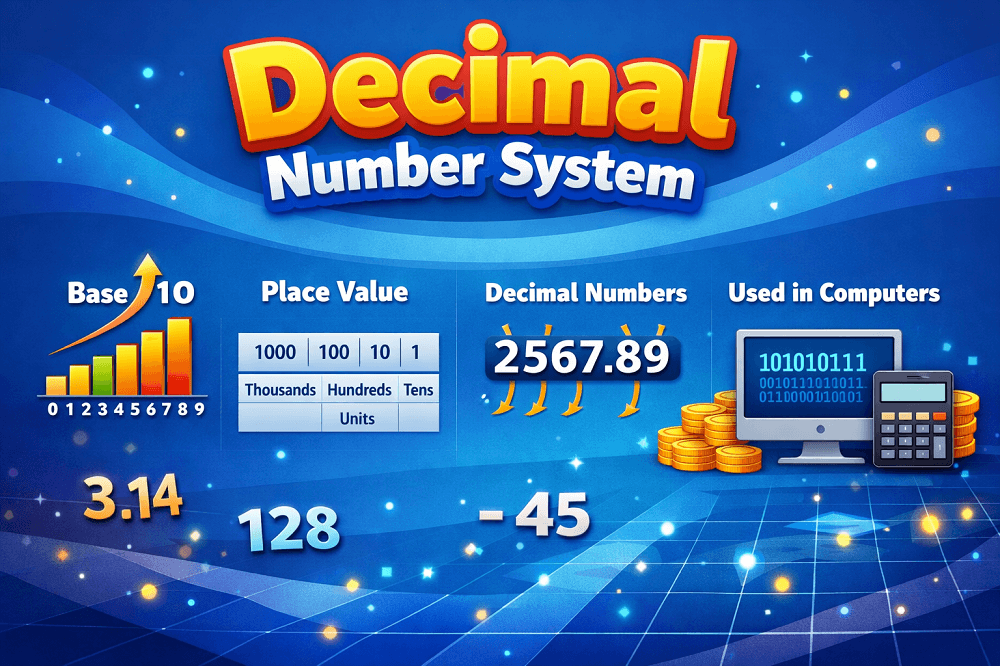
Introduction to the Decimal Number System
The Decimal Number System is the most commonly used number system in our daily lives. From counting money, measuring distance, checking temperature, to performing calculations in schools and offices, everything is based on the decimal system.
In the field of computers and digital electronics, understanding the decimal number system is very important because it acts as a bridge between humans and machines. While computers internally use binary numbers, humans interact with computers using decimal numbers.
This article explains the Decimal Number System step by step, in very simple language, covering:
- Definition
- Base
- Digits
- Place values
- Number representation
- Uses of the decimal number system in computers
- Advantages, limitations, examples, and FAQs
What is the Decimal Number System? (Definition)
The Decimal Number System is a number system that uses 10 digits to represent numbers. These digits range from 0 to 9.
Definition:
The decimal number system is a positional number system that uses base 10 and digits from 0 to 9 to represent numeric values.
It is called “decimal” because the word decimal comes from the Latin word “decem”, which means ten.
Example:
- 125
- 49
- 2024
- 3.14
All these numbers are written using the decimal number system.
Base of the Decimal Number System
What is Base?
The base (or radix) of a number system indicates:
- How many unique digits are used
- How place values increase
Base of Decimal Number System = 10
This means:
- It uses 10 digits (0–9)
- Each place value is a power of 10
Why Base 10?
Humans traditionally use base 10 because:
- We have 10 fingers
- It is easy to count and do calculations
Digits Used in the Decimal Number System
The decimal system uses exactly 10 digits:
| Digits |
|---|
| 0 |
| 1 |
| 2 |
| 3 |
| 4 |
| 5 |
| 6 |
| 7 |
| 8 |
| 9 |
Using only these digits, any number—small or large—can be formed.
Important Point:
No other symbols or digits are allowed in the decimal number system.
Place Value in the Decimal Number System
The decimal number system is a positional number system, which means the value of a digit depends on its position.
Place Value Chart
| Place | Power of 10 |
|---|---|
| Units | 10⁰ |
| Tens | 10¹ |
| Hundreds | 10² |
| Thousands | 10³ |
| Ten Thousands | 10⁴ |
| Lakhs | 10⁵ |
| Millions | 10⁶ |
Example: Place Value Explanation
Consider the number 5734
| Digit | Place | Value |
|---|---|---|
| 5 | Thousands | 5 × 1000 = 5000 |
| 7 | Hundreds | 7 × 100 = 700 |
| 3 | Tens | 3 × 10 = 30 |
| 4 | Units | 4 × 1 = 4 |
Total Value:
5000 + 700 + 30 + 4 = 5734
Place Value in Decimal Fractions
Decimal system also supports fractional values using a decimal point (.)
Example: 45.678
| Digit | Place | Value |
|---|---|---|
| 4 | Tens | 40 |
| 5 | Units | 5 |
| . | Decimal Point | — |
| 6 | Tenths | 6/10 |
| 7 | Hundredths | 7/100 |
| 8 | Thousandths | 8/1000 |
This makes the decimal system very useful for precise measurements.
Decimal Number Representation
General Representation Formula
A decimal number can be represented as:
N=∑(Digit×10position)N = \sum (Digit × 10^{position})N=∑(Digit×10position)
Example:
Decimal number 246
=(2×10²)+(4×101)+(6×100)= (2 × 10^2) + (4 × 10^1) + (6 × 10^0)=(2×10²)+(4×101)+(6×100) =200+40+6=246= 200 + 40 + 6 = 246=200+40+6=246
Types of Decimal Numbers
1. Integer Decimal Numbers
- No fractional part
- Example: 10, 245, 999
2. Fractional Decimal Numbers
- Contains decimal point
- Example: 3.5, 0.75, 12.99
3. Positive Decimal Numbers
- Example: 15, 6.25
4. Negative Decimal Numbers
- Example: -10, -3.14
Use of the Decimal Number System in Computers
Although computers work internally using binary numbers (0 and 1), the decimal number system plays a vital role in computing.
1. User Interaction
Humans input data in decimal form, such as:
- Age: 25
- Price: 199.99
- Marks: 87
Computers convert these decimal numbers into binary for processing.
2. Input and Output Representation
- Input devices (keyboard, touchscreen) accept decimal numbers
- Output devices (monitor, printer) display results in decimal form
This makes computers human-friendly.
3. Programming and Software
In programming:
- Loop counters
- Variables
- User inputs
- Memory size display
are often shown in decimal format.
Example:
Enter a number: 100
4. Financial and Business Applications
The decimal system is essential for:
- Banking software
- Accounting systems
- Billing applications
- Tax calculations
Binary alone cannot efficiently represent money values.
5. Data Conversion
Computers frequently perform:
- Decimal to Binary conversion
- Binary to Decimal conversion
This conversion allows:
- Machine efficiency (binary)
- Human readability (decimal)
6. Measurement and Scientific Data
Decimal numbers are used in:
- Temperature readings
- Scientific calculations
- Engineering measurements
- Medical equipment output
Accuracy is better handled using decimal representation.
Advantages of the Decimal Number System
- Easy to understand
- Natural for humans
- Supports fractions
- Used in daily life
- Standard system for education
- Suitable for financial calculations
Limitations of the Decimal Number System in Computers
- Computers cannot process decimals directly
- Requires conversion to binary
- Slower processing compared to binary
- More storage is needed internally
Decimal Number System vs Other Number Systems
| Feature | Decimal | Binary | Octal | Hexadecimal |
|---|---|---|---|---|
| Base | 10 | 2 | 8 | 16 |
| Digits | 0–9 | 0–1 | 0–7 | 0–9, A–F |
| Used by Humans | Yes | No | Limited | Limited |
| Used by Computer | Indirect | Yes | Yes | Yes |
Real-Life Examples of the Decimal System
- ATM balance
- Mobile recharge amount
- Exam scores
- Speed of the vehicle
- Electricity bill
Importance of the Decimal Number System
The decimal number system is important because:
- It simplifies communication between humans and computers
- It forms the foundation of mathematics
- It is universally accepted
- It supports accurate calculations
Q1. What is the decimal number system?
The decimal number system is a base-10 number system that uses digits from 0 to 9 to represent numbers.
Q2. Why is the decimal number system called base 10?
Because it uses 10 unique digits, and each place value is a power of 10.
Q3. How many digits are used in the decimal system?
The decimal system uses 10 digits (0–9).
Q4. Do computers use the decimal number system?
Computers do not use decimal internally, but they accept and display decimal numbers for user interaction.
Q5. What is place value in the decimal number system?
Place value defines the value of a digit based on its position, such as units, tens, hundreds, etc.
Q6. Why is the decimal number system important in computers?
It helps humans easily input, understand, and interpret data processed by computers.
Conclusion
The Decimal Number System is the most important and widely used number system for humans. It provides a simple, logical, and powerful way to represent numbers, perform calculations, and communicate with computers.
While computers operate internally using binary numbers, the decimal system remains essential for user interaction, education, finance, and real-world applications.
Understanding the decimal number system is a fundamental step toward learning computer science, programming, and digital technology.
Leave a Comment
Your email address will not be published. Required fields are marked *
Related Post
Git & GitHub Version Control Tutorial for Beginners
Learn Git & GitHub Version Control with this complete beginner-to-advanced guide. Understand Git commands, repositories, branching, merging,
CI/CD Pipelines Complete Guide – Continuous Integration
Learn everything about CI/CD Pipelines in this complete guide. Understand Continuous Integration, Continuous Deployment.
DevOps: Ultimate Guide to DevOps Practices, Tools
Explore the complete DevOps guide for 2026. Learn DevOps practices, tools, benefits, CI/CD pipelines, automation, culture, and more.
What is Cloud Platforms? Types, Benefits
Learn everything about Cloud Platforms. Understand cloud computing platforms, types, benefits, services, use cases, security, and future trends.
Encryption: Types, Algorithms, Security and Data Encryption
Learn everything about Encryption in this complete guide. Understand what encryption is, types of encryption, algorithms, advantages, data security.
Ethical Hacking: Complete Guide, Tools, Techniques
Learn Ethical Hacking in this complete guide. Understand ethical hackers, types, tools, techniques, and cybersecurity best practices.
Network Security and Firewalls – Types, Architecture
Learn Network Security & Firewalls in detail. This complete guide covers concepts, types of firewalls, architecture, security threats, and more.
Network Routing and Switching – Types, Protocols & Working
Learn everything about Network Routing and Switching. Understand concepts, types, protocols, devices, differences, advantages, and more.
IP Addressing - IPv4, IPv6, Working, Types, Structure, Security
Internet Protocol (IP) is the foundation of the internet. Learn everything about IP, including IPv4, IPv6, IP addressing, packet delivery, and more.
Transmission Control Protocol (TCP) - Working, Features, Use
Learn everything about Transmission Control Protocol (TCP) in this complete SEO-friendly guide. Understand TCP definition, and more.